

Measurement Uncertainty in Practice: What Laboratories Need to Demonstrate

Measurement uncertainty remains one of the most misunderstood requirements of ISO/IEC 17025 and ISO 15189.
For some laboratories, it is viewed as a mathematical exercise. For others, it is seen as a compliance requirement that must be satisfied because the standard says so. In reality, measurement uncertainty is neither of these things in isolation.
Measurement uncertainty is a way of expressing how much confidence can be placed in a measurement result and the range within which the true value is likely to lie.
At its core, measurement uncertainty helps laboratories understand and communicate the confidence that can be placed in their results. It supports decision-making, demonstrates technical competence, and provides transparency regarding the limitations of a measurement.
In this article, we look at measurement uncertainty from a practical laboratory perspective and discuss what laboratories need to demonstrate to assessors under ISO/IEC 17025 and ISO 15189.
Why Measurement Uncertainty Matters
Every measurement contains some level of uncertainty.
Imagine you step on your bathroom scales, and it says:
80.0 kg
Do you actually weigh exactly 80.000000 kg? Probably not.
Maybe if you stepped off and back on again, it would read:
- 79.9 kg
- 80.1 kg
- 80.0 kg
The scales are giving you their best estimate, but there is always some variation.
Measurement uncertainty is simply a way of saying:
“We believe the true value is probably somewhere within this range.”
No instrument is perfect. No measurement process is completely free from variation. Environmental conditions, equipment performance, operator technique, reference standards, and sampling all contribute to uncertainty in some way.
The purpose of measurement uncertainty is not to eliminate these influences. Rather, it is to understand them well enough to determine whether they could affect the interpretation of results.
This is why measurement uncertainty is more than just a number in a spreadsheet. It is evidence that the laboratory understands its measurement process and has considered the factors that influence the reliability of its results.
Moving Beyond the Spreadsheet
One of the most common misconceptions is that measurement uncertainty begins and ends with a calculation. The MU process is so much more than that!
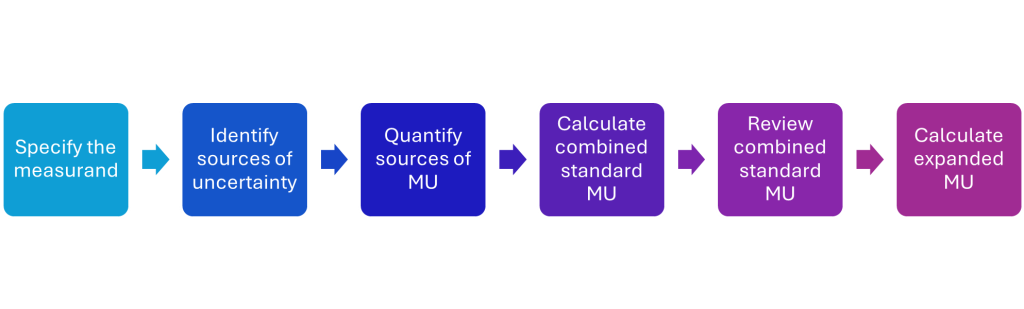
Figure 1: Process for Estimation of Measurement Uncertainty
Often, the earlier steps in the process of estimating MU, of properly specifying the measurand (the “thing” that is being measured) and identifying the contributors to measurement uncertainty, reveal some surprising information. It’s also where labs can demonstrate that they truly understand what’s happening in the measurement process and, hence, have greater depth of technical competence.
At the end of the MU process, once you have the magic MU number, many labs struggle to explain how the information is used in practice.
Assessors are increasingly interested in understanding:
- How uncertainty was determined
- Whether the approach is appropriate
- Whether assumptions have been justified
- How uncertainty affects the interpretation of results
- Whether staff understand the significance of the uncertainty estimate
A perfectly constructed spreadsheet means very little if the lab staff cannot explain what it represents and why it is appropriate.
Why Laboratories Struggle With Measurement Uncertainty
Measurement uncertainty often presents challenges because it sits at the intersection of science, statistics, and quality management.
We often see difficulties such as:
- Overly complex calculations that are difficult to maintain, and in some cases, explain to assessors
- Uncertainty budgets copied from templates without critical review
- Use of precision as the only contributor to MU
- Failure to review uncertainty estimates as methods evolve
- Treating uncertainty as a one-off exercise
- Limited understanding among staff responsible for reporting results
In many cases, the challenge is not calculating uncertainty. It is demonstrating that the uncertainty estimate remains relevant, justified, and fit for purpose.
Common Measurement Uncertainty Mistakes
While every lab is different, several issues appear repeatedly during assessments.
-
Focusing on Precision Alone
Precision is important, but it is only one contributor to uncertainty.
A narrow focus on repeatability can overlook other significant sources of variation like accuracy (bias) and equipment performance.
-
Including Everything Possible
Some labs attempt to include every conceivable contributor. This can result in complex uncertainty budgets that are difficult to defend and maintain.
The goal is not to identify every possible influence. The goal is to identify the influences that are significant to the measurement. But to demonstrate this is valid, you should start from a position of identifying and quantifying some contributors to MU that you consider insignificant and check that the assumptions hold in the face of the combined measurement uncertainty estimate.
-
Never Reviewing the Estimate
Be honest! When was the last time you reviewed your MU estimates?
Methods change. Equipment changes. Staff change. Measurement uncertainty estimates should be reviewed periodically to ensure they remain valid.
Typical triggers for review are:
- When equipment is recalibrated
- When there is an update to how a method is performed
- When new staff are being assessed for competence
- When new CRMs are used
-
Treating the Calculation as the Outcome
The calculation itself is not the objective. It’s just a step along the way in its application. Understanding the significance of the uncertainty estimate is far more important than producing the number.
What Assessors Are Looking For
When assessing measurement uncertainty, assessors are generally seeking evidence that the laboratory:
- Understands the measurement process

- Has identified significant sources of uncertainty
- Uses an appropriate estimation method
- Can justify assumptions and exclusions
- Reviews uncertainty estimates when required
- Understands the impact of uncertainty on results
Assessors are rarely looking for the most sophisticated statistical model. They are looking for a practical, technically sound, and defensible approach.
A simple uncertainty estimate that is well understood and covers all significant sources of uncertainty is often preferable to a highly complex model that nobody can explain.
Measurement Uncertainty and Decision Making
 Measurement uncertainty becomes particularly important when results are close to a specification limit, regulatory threshold, or acceptance criterion. In these situations, uncertainty can influence the confidence associated with a decision. This is where concepts such as decision rules become increasingly important. Understanding uncertainty helps ensure that decisions are based on evidence rather than assumptions.
Let’s start by exploring what information needs to be reported about MU.
Testing labs do not always have to report MU. In fact, in ISO/IEC 17025, there are only 3 conditions where this is required:
- it is relevant to the validity or application of the test results, which is usually something that the user of the test results will decide, or could be specified as a reporting requirement for a test method
- the customer asks for MU to be reported
- MU affects conformity to a specification limit.
If you don’t know the specification limit or whether it is relevant to the validity or application of the test results, there is no requirement to report MU.
If you work in a human pathology lab, there is no requirement to report MU, only that information is provided to users on request. Personally, I love to ask that question when the result is close to the clinical decision limit or at least hazard a guess on what it might be. It could be the difference between medication or no medication ….. and I hate taking tablets!
If you’re working in a calibration laboratory, it is a requirement to report MU.
If you do have to report MU, you should consider:
- How uncertainty affects compliance decisions
- Whether customers understand the implications
- How decision rules are communicated
- Whether reporting practices remain consistent
You might even like to take a look at this useful Guide from Eurachem.
Keeping Measurement Uncertainty Practical and Defensible
A practical approach to measurement uncertainty should:
- Be appropriate for the measurement being performed
- Reflect the actual process used by the laboratory
- Be understandable to those responsible for applying it
- Be reviewed when circumstances change
- Support technical decision-making
Now is the time to really look at your MU estimates and ask yourself, how well can you defend your lab’s MU work against these metrics?
The most effective uncertainty systems are not necessarily the most complicated. They are the ones that are understood, maintained, and consistently applied.
What This Means for Laboratories
Measurement uncertainty is not about producing numbers for the sake of compliance. It is about understanding the confidence that can be placed in a result and being able to explain that confidence to customers, regulators, and accreditation assessors.
 Measurement uncertainty is often viewed as a technical hurdle. When approached practically, measurement uncertainty becomes more than a requirement of ISO/IEC 17025 or ISO 15189. In reality, it is an opportunity to demonstrate competence.
A lab that can explain:
- how uncertainty was estimated,
- why the approach is appropriate,
- and how uncertainty influences decisions,
is demonstrating exactly the type of understanding assessors are looking for.
It becomes evidence of technical competence.
And ultimately, that is what accreditation is designed to demonstrate.
FAQs
What is measurement uncertainty?
Measurement uncertainty is a way of expressing how much confidence can be placed in a measurement result. It recognises that no measurement is perfect and provides an estimate of the range within which the true value is likely to lie.
Why is measurement uncertainty important in ISO/IEC 17025 and ISO 15189?
ISO/IEC 17025 and ISO 15189 require laboratories to understand and control factors that may affect the validity of their results. Measurement uncertainty helps demonstrate technical competence and provides confidence that results are fit for their intended purpose.
Does every laboratory need to calculate measurement uncertainty?
Not every activity requires a detailed uncertainty calculation. However, laboratories must determine where measurement uncertainty is relevant and be able to justify their approach. The extent of evaluation should be appropriate to the type of testing or calibration being performed.
What are assessors looking for when reviewing measurement uncertainty?
Assessors typically look for evidence that the laboratory understands its measurement process, has identified significant sources of uncertainty, can justify its calculations and assumptions, and understands how uncertainty affects the interpretation of results.
Is a complex uncertainty budget always better?
No. A complex uncertainty budget is not necessarily a better one. Assessors generally prefer an approach that is technically sound, practical, well understood by staff, and appropriate for the measurement being performed.
How often should measurement uncertainty be reviewed?
Measurement uncertainty should be reviewed whenever significant changes occur, such as changes to equipment, methods, reference standards, environmental conditions, or other factors that could affect the validity of the estimate. Periodic review should also form part of normal quality system activities.
What is the difference between measurement uncertainty and error?
Error is the difference between a measured value and the true value. It is something that is known and can be corrected. Measurement uncertainty is an estimate of the range within which the true value is likely to lie. Uncertainty helps quantify confidence in a result, whereas error represents a specific deviation.
How does measurement uncertainty affect decision-making?
Measurement uncertainty becomes particularly important when results are close to a specification limit, regulatory threshold, or acceptance criterion. In these situations, uncertainty can influence confidence in a pass/fail or compliant/non-compliant decision.
What is the most common mistake laboratories make with measurement uncertainty?
One of the most common mistakes is treating measurement uncertainty as a spreadsheet exercise rather than a tool for understanding and communicating confidence in results. Laboratories should be able to explain not only how uncertainty was calculated, but also how it is used in practice.
Can measurement uncertainty improve laboratory performance?
Yes. Understanding measurement uncertainty can help laboratories identify significant sources of variation, improve methods, strengthen decision-making, and demonstrate technical competence to customers, regulators, and accreditation bodies.