

Why Laboratories Keep Getting the Same Nonconformances

Recurring laboratory nonconformances are frustrating, particularly when a laboratory believes the original issue had already been addressed. When the same or a similar finding appears at successive internal audits or ISO 17025 / NATA assessments, it is tempting to blame the technical issue, the assessor or the standard itself. But the real problem may lie in the laboratory’s nonconformance and corrective action process.
Perhaps equipment calibration is particularly difficult to manage. Perhaps staff competence records are never quite complete. Perhaps technical records are an assessor’s favourite place to look for trouble.
Sometimes there is truth in these explanations. However, when a nonconformance keeps returning, the underlying problem is often not the technical issue that was identified. It is the laboratory’s process for investigating, correcting, and closing nonconformances.
The immediate problem may have been fixed, but the reason it occurred has not.
Key takeaway: When laboratory nonconformances recur, the problem is often not the original technical failure. It is an ineffective process for investigating the extent of the problem, identifying its cause, selecting corrective action, and confirming that the action worked.
The nonconformance that never really went away
Recurring nonconformances do not always return in exactly the same form.
One assessment may identify an item of equipment that has passed its calibration due date. The lab updates the calibration register and arranges the overdue calibration.
At the next assessment or internal audit, the equipment may be within calibration, but the assessor finds that several maintenance activities have not been completed. At a later assessment, reference materials have expired without anyone noticing.
These may be recorded as different findings, but they could all point to the same underlying weakness: the lab does not have an effective system for identifying, scheduling, assigning and monitoring time-dependent activities.
The original correction addressed one overdue calibration. It did not address the system that allowed it to become overdue.
This distinction matters because recurring nonconformances are not always repetitions. Sometimes they are variations of the same systemic problem.
The poll result that deserves attention
What Laboratory Professionals Told Us
In a recent MAS Management Systems poll, 58 per cent of respondents identified responding to accreditation conditions as the most challenging stage of accreditation. Only 8 per cent selected the assessment itself.
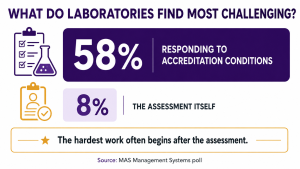
I recently asked laboratory professionals which stage of accreditation they found most challenging.
Only 8 per cent selected the assessment itself. In contrast, 58 per cent selected responding to conditions. That result is revealing.
Labs usually understand that they need to prepare for an assessment. They review documents, check records, speak with staff and try to identify obvious gaps. Once the assessment is over, however, the lab must move from identifying problems to understanding and resolving them. That’s where the harder work begins.
Responding effectively to a condition requires the laboratory to:
- understand exactly what the condition means
- correct the specific problem identified
- determine whether other work or records may be affected
- establish why the problem occurred
- implement action that addresses the cause
- provide evidence that the action was implemented
- demonstrate that it has been effective.
If any link in this chain is weak, the condition may be closed administratively without the underlying problem being resolved.
Correction is not corrective action
One of the most common reasons nonconformances recur is confusion between correction and corrective action.
A correction fixes the problem that has been found.
Corrective action addresses the cause so that the problem is less likely to happen again.
For example, an assessor discovers that a staff member performed a test without a current competence authorisation. The lab responds by completing the missing competence assessment and updating the staff member’s authorisation.
That is a correction.
The corrective action should address why the authorisation was allowed to lapse or why the staff member was able to continue working without it. Possible causes might include:
- no defined responsibility for monitoring authorisations
- no reminder or escalation process
- an incomplete competence register
- supervisors not checking authorisation before allocating work
- a mismatch between the competence procedure and operational practice
- workload pressures that made the required assessment difficult to schedule.
If the laboratory only updates the individual record, the immediate condition may appear to be resolved. The system remains unchanged, and another staff member’s authorisation may lapse later.
Root cause analysis often stops too soon
 Laboratories are generally good at determining what happened. That often comes from working as a scientist or engineer. Lab staff may be less successful at establishing why it happened.
There is often pressure to respond quickly to assessment conditions. Those 4 weeks pass quickly. Under that pressure, the most visible explanation can be accepted as the root cause:
- staff oversight
- human error
- failure to follow the procedure
- lack of training
- an isolated incident.
These statements may describe the event, but they rarely explain it.
If a competent staff member did not follow a procedure, the investigation should explore why. Was the procedure difficult to locate? Was it inconsistent with the way the work was actually performed? Was the employee interrupted or overloaded? Did the form encourage a step to be skipped? Was supervision inadequate? Had an informal workaround become normal practice?
“Human error” should usually be the beginning of an investigation, not its conclusion. It’s rarely (if ever) the root cause of the problem. Why? Because humans don’t usually intend to make an error!
Retraining is also frequently selected as the default corrective action, even when there is no evidence that a lack of knowledge caused the problem. Training someone again will not fix an unclear process, an unrealistic workload, a poorly designed form, or a system without appropriate controls.
The laboratory investigates the incident, not the system
A narrow investigation asks, “Why was this calibration missed?”
A stronger investigation also asks:
- Could other calibrations have been missed?
- Does the same monitoring process cover maintenance, reference materials, and environmental checks?
- Who is responsible for reviewing upcoming due dates?
- What happens when the responsible person is absent?
- Is there an escalation process for overdue activities?
- How does management know the system is working?
The first question may resolve the individual incident. The broader questions test the system.
This is particularly important when apparently different findings have a common cause. Incomplete technical records, missing review signatures and undocumented calculations may all result from a record template that does not match the testing process. Treating each missing entry separately will create repeated corrections without improving the record system.
The corrective action does not match the cause
Even where a lab identifies a reasonable root cause, the action taken may not address it.
Consider a lab that concludes an outdated method was used because the analyst did not know that a new version had been issued. Its response is to remind all staff to check the current method before commencing work.
However, if superseded methods remain available in the testing area, staff rely on uncontrolled printed copies, or changes to methods are not communicated effectively, a reminder is a weak control. It depends entirely on people remembering to compensate for a flawed system.
More effective actions might include:
- removing or clearly identifying superseded versions
- improving document access at the point of use
- introducing automatic notifications when controlled documents change
- requiring technical review of significant method changes
- confirming that affected staff understand the revised requirements
- checking implementation through observation or record review.
Corrective action should change the conditions that allowed the problem to occur. It should not simply ask people to be more careful.
Effectiveness is assumed rather than demonstrated
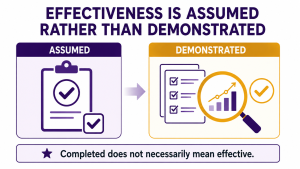 Updating a procedure does not prove that practice has changed. Retraining staff does not prove that they are applying the training. Adding a field to a form does not prove that the field is completed correctly or that the information is reviewed.
A laboratory may close a nonconformance as soon as the planned action is completed. This confirms implementation, but not effectiveness. An effectiveness review should ask whether the action produced the intended result. Depending on the issue, evidence might include:
- reviewing a representative sample of subsequent technical records
- observing staff performing the activity
- confirming that scheduled tasks were completed over an appropriate period
- checking that no similar incidents or complaints have occurred
- analysing quality control or proficiency testing results
- conducting a targeted internal audit
- asking staff to explain the revised process and the reason for it.
The review period must also be meaningful. A monthly activity cannot be shown to be effective the day after a new procedure is issued.
Sometimes a nonconformance should remain open while sufficient evidence is gathered. An arbitrary closure date should not be allowed to substitute for evidence.
Internal audits may be checking compliance, not effectiveness
Recurring findings can also indicate a weakness in the internal audit program.
An internal audit may confirm that:
- a procedure exists
- a calibration register is maintained
- competence records are available
- nonconformance reports have been completed.
These checks are useful, but they may not show whether the processes are effective.
A stronger audit follows activities through the system or process. It might select a reported result and trace the sample, method, equipment, environmental conditions, quality control, calculations, technical review and staff authorisation.
It should also examine several closed nonconformances and ask whether the stated causes were supported by evidence, whether the actions addressed those causes and whether effectiveness was genuinely evaluated.
An internal audit should not merely confirm that the laboratory has a corrective action process. It should determine whether that process prevents recurrence.
Do Different NATA Assessors Focus on Different Issues?

Labs sometimes feel that particular assessors arrive with favourite topics or different interpretations of requirements.
Assessors are human, and they bring different technical backgrounds, experiences and areas of focus. One assessor may examine measurement uncertainty closely, while another spends more time on technical records, staff competence or equipment traceability.
This can make an issue feel new even when the lab staff believed it had already been accepted at a previous assessment.
However, an assessor’s area of interest does not necessarily make the finding invalid. A fresh assessor may identify a weakness that was previously overlooked. Requirements and accreditation body expectations may also evolve, and the laboratory’s activities may have changed since the last assessment.
The important questions are:
- What specific requirement has not been met?
- What objective evidence supports the finding?
- Is the finding within the laboratory’s accredited or proposed scope?
- Is the assessor seeking evidence against the original requirement, or introducing an additional expectation?
- Has the condition been expressed clearly enough for the laboratory to respond appropriately?
Where the requirement, evidence and gap are unclear, the lab should seek clarification. It is much better to resolve ambiguity early than to complete extensive corrective action that does not address the assessor’s concern.
At the same time, “the assessor always picks on this” should not become a reason to dismiss a pattern. If several assessors identify related weaknesses, there may be a systemic issue that the laboratory has normalised.
Creeping criteria and moving targets
Some laboratories experience what feels like “creeping criteria”. They respond to a condition, only to receive further questions or requests for additional evidence that appear to expand the original finding.
There are several possible explanations.
The initial response may have exposed a broader issue. The proposed action may not address the identified cause. The laboratory may have demonstrated implementation but not effectiveness. Alternatively, the original condition may not have been sufficiently clear, or additional expectations may genuinely have been introduced during the closure process.
The best defence against a moving target is a clear line of sight between the requirement and the effective action:
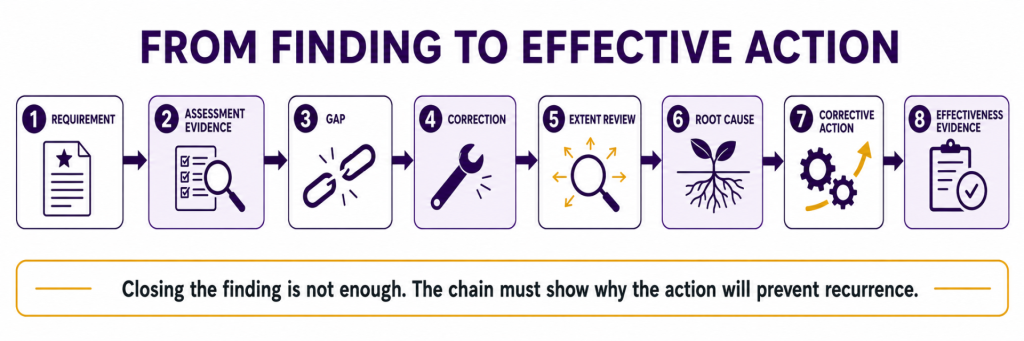
If that chain is documented clearly, both the laboratory and the assessor can see what is being addressed and why.
Management review misses the pattern
Individual nonconformances are often reviewed and closed separately. As a result, the lab staff may fail to notice that several findings point to the same underlying weakness.
Management review should consider more than the number of nonconformances raised. It should examine:
- recurring nonconformance themes and causes
- findings across different laboratory activities
- repeated use of “human error” or “retraining” as responses
- overdue corrective actions
- actions closed without adequate effectiveness evidence
- issues identified by external assessment but missed by internal audits
- whether previous corrective actions created sustainable change.
A laboratory with ten unrelated minor findings may have less systemic risk than a laboratory with three findings caused by the same ineffective control.
Counting nonconformances is not the same as understanding them.
Breaking the cycle
When a familiar nonconformance returns, the laboratory should resist the urge to fix it quickly and move on.
Instead, ask:
- Is this genuinely a new problem, or another expression of an earlier weakness?
- Did the previous investigation identify a cause supported by evidence?
- Did the corrective action address that cause, or only the immediate incident?
- Was the extent of the problem investigated across other records, staff, methods or equipment?
- Was effectiveness assessed after enough time had passed?
- Did the internal audit program test whether the change became normal practice?
- Has management considered patterns across apparently unrelated findings?
The answer is rarely more paperwork. Laboratories need better questions, stronger investigations and evidence that actions have changed the way work is performed.
Don’t panic, but do look deeper
In The Hitchhiker’s Guide to the Galaxy, “Don’t Panic” is excellent general advice, but it is not a complete problem-solving method.
The same applies to recurring nonconformances. They should not trigger panic, blame or a frantic rewrite of every procedure. They should prompt curiosity.
Why did the system allow this to happen? Where else could it happen? What needs to change? How will we know the change worked?
When laboratories keep receiving the same types of nonconformances, the problem may not be calibration, competence, technical records or document control. It may be the process used to respond to problems.
Fixing the finding may close the condition. Fixing the system is what prevents it from coming back.
Download the corrective action worksheet Laboratory_Nonconformance_and_Corrective_Action_Worksheet
FAQs
What is a recurring nonconformance in a laboratory?
A recurring nonconformance is a problem that reappears after it was believed to have been corrected. It may return as exactly the same issue or appear in a different form because the underlying weakness in the laboratory’s system was never fully addressed.
Why do laboratories keep getting the same nonconformances?
Recurring nonconformances commonly occur when the laboratory corrects the immediate problem but does not identify and address its underlying cause. Other contributing factors include narrow investigations, ineffective corrective actions, inadequate internal audits and closing actions without evidence that they have worked.
What is the difference between correction and corrective action?
A correction fixes the specific problem that has been identified. Corrective action addresses the cause of the nonconformance to reduce the likelihood of recurrence. For example, calibrating an overdue instrument is a correction. Improving the laboratory’s system for monitoring and escalating calibration due dates is corrective action.
How should a laboratory conduct root cause analysis?
Root cause analysis should look beyond what happened and explore why the laboratory’s controls allowed it to happen. The investigation should consider factors such as process design, responsibilities, workload, supervision, communication, document accessibility, and workplace practices. Statements such as “human error” or “failure to follow the procedure” rarely provide a complete root cause.
Why is retraining not always an effective corrective action?
Retraining is appropriate when a lack of knowledge or skill caused the nonconformance. It will not resolve problems caused by unclear procedures, poorly designed records, inadequate resources, unrealistic workloads, or ineffective monitoring. The corrective action should match the cause identified through the investigation.
What is an extent review in a nonconformance investigation?
An extent review determines whether the identified problem affects other records, results, staff, equipment, methods or laboratory activities. It helps the laboratory establish whether the finding is an isolated incident or evidence of a broader systemic problem.
How can a laboratory demonstrate corrective action effectiveness?
The laboratory should collect objective evidence showing that the action has produced the intended change. This may include reviewing subsequent technical records, observing staff, checking completion of scheduled activities, conducting a targeted internal audit or analysing quality control results. Completing an action does not, by itself, demonstrate effectiveness.
When should a laboratory close a nonconformance?
A nonconformance should be closed when the correction and corrective action have been implemented and there is sufficient evidence that the action has been effective. The review period should reflect the nature and frequency of the activity. A monthly process, for example, cannot usually be demonstrated as effective immediately after the change is introduced.
Can different NATA assessors focus on different issues?
Yes. Assessors may have different technical backgrounds and may examine particular aspects of laboratory operations more closely. However, every nonconformance should still be linked to a specific accreditation requirement and supported by objective evidence. Laboratories should seek clarification when the requirement, evidence or identified gap is unclear.
What should a laboratory do if a NATA condition appears to keep expanding?
The laboratory should clarify the relationship between the original requirement, the assessment evidence, the identified gap and any additional evidence being requested. Further questions may be necessary to demonstrate effective action, but they should remain connected to the original finding. A clearly documented response chain can help prevent misunderstandings or apparent “creeping criteria.”
How can internal audits help prevent recurring nonconformances?
Internal audits should test whether laboratory processes work in practice, not simply confirm that procedures and records exist. Auditors should trace activities through the system, examine previous nonconformances and verify that corrective actions have resulted in sustained change.
Does ISO/IEC 17025, ISO 15189 and ISO/IEC 17020 require laboratories to eliminate every nonconformance?
The Standards do not assume that a competent laboratory will never experience a nonconformance. It requires laboratories to control nonconforming work, evaluate its significance, take appropriate action, and implement corrective action when a nonconformance could recur. A strong quality system is demonstrated by how effectively the laboratory identifies, investigates, and learns from problems.