

Houston, we have a problem!

Why Laboratories Keep Getting the Same Nonconformances
There are some things you never want to hear.
Words like “uh oh” from your hairdresser when they’re standing behind you during a haircut.
Or “I’ve never seen THAT before” when your doctor is looking at an X-ray.
Or perhaps “Houston, we have a problem” when you’re sitting in Mission Control during a space flight.
Just like in a space flight, in a lab setting, any issues that arise will be the result of something going wrong in the system. And finding out what went wrong means that an investigation needs to be launched.
Repeated nonconformances in ISO 17025 laboratories are often a sign that corrective actions are addressing symptoms rather than underlying system issues. The reality is, most labs don’t struggle with identifying problems, or their more technical term, nonconformances. They struggle with not seeing them again.
The same issues reappear over time. Sometimes in exactly the same form. Sometimes slightly different, but clearly related. Each time, they are addressed, closed out, and recorded. Yet they return.
This is not usually a failure of effort. It is a sign that the system is not learning in the way it needs to. This occurs because of several reasons.
When Closing the Issue Becomes the Goal
In many labs, the focus of the nonconformance process is on closing the issue. Often, this is as fast as possible so they can show off their dedication and efficiency.
The event is recorded. A cause is identified. An action is assigned. The item is marked as complete.
From a compliance perspective, the process has been followed. But, from a system perspective, something is missing.
Closing a nonconformance does not necessarily mean that the underlying issue has been resolved. It often means that the immediate problem has been dealt with. A band-aid has been applied. But the conditions that allowed it to occur may still exist.
When the process is driven by closure rather than understanding, repetition becomes more likely.
The Difference Between Symptoms and Causes

One of the most common reasons nonconformances recur is that the response addresses the symptom rather than the cause.
A result is reported incorrectly, so an additional check is introduced. A sample is mishandled, so a reminder is issued. A form is completed incorrectly, so instructions are clarified.
These actions are not wrong. They may reduce the likelihood of recurrence in the short term. Over time, they often add to greater complexity in the system.
However, they do not always address why the issue occurred in the first place.
The underlying cause may relate to:
- unclear processes
- inconsistent training
- workload pressures
- system design
- assumptions about how work is performed
Unless these factors are explored, the same conditions remain in place.
Understanding How Work Is Actually Done
Effective investigation begins with a clear understanding of how the work is carried out in practice.
There is often a difference between:
- what the procedure says
- what people believe happens
- what actually happens
Nonconformances tend to occur in the space between these.
Taking the time to observe and understand real workflows can reveal issues that are not visible in documentation alone. It also provides context that is essential for identifying meaningful causes.
The Role of Consistency
Where processes are applied inconsistently, variation increases. With variation comes a greater likelihood of error.
If different staff approach the same task in different ways, even within acceptable limits, the system becomes harder to control.
Consistency does not mean rigidity. It means that tasks are performed in a way that is understood, repeatable, and supported by the system. Our previous article on Turning Conformance Into Working Systems explored how documentation that is “just right” can contribute to consistency.
Where consistency is lacking, nonconformances are more likely to recur.
When Systems Become Too Complex
 Over time, systems often grow in response to issues.
Additional steps are introduced. Extra checks are added. More documentation is created. Each change is made with the intention of preventing recurrence. The cumulative effect can be a system that is difficult to follow and harder to apply consistently.
In these environments, nonconformances can become a symptom of complexity rather than a lack of control. Simplifying processes, where possible, can be more effective than adding further layers. Reviewing all lab processes for unnecessary complexity is an essential part of this.
Nonconformances as Inputs to Improvement
Nonconformances provide valuable information.
They show where assumptions have not held. They highlight where controls have not worked as intended. They point to areas where the system may need to be adjusted. They highlight risks you may not have identified.
When treated as isolated events, their value is limited. But when viewed collectively, patterns begin to emerge.
Repeated issues in similar areas often indicate:
- weaknesses in process design
- gaps in competence
- unclear responsibilities
- or misalignment between documentation and practice
Recognising these patterns is a key step in strengthening the system. That requires some thinking and focus. Fortunately, humans are good at pattern recognition, especially with a good beverage and cake in hand. 😉
Moving Beyond Individual Fixes
Addressing individual issues is a necessary activity in managing non-conformances. It ensures that immediate problems are contained. However, lasting improvement requires a broader view.
This may involve considerations such as:
- reviewing how processes are designed
- considering how work is allocated
- examining how information flows through the system
- reassessing how competence is defined and maintained
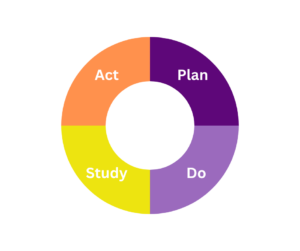
These are not always quick fixes. They are, however, where meaningful change occurs. Management reviews are the perfect vehicle for going beyond the individual fixes if your corrective action process does not follow a Plan-Do-Study-Act (PDSA) cycle.
What Effective Corrective Action Looks Like
In a well-functioning system, your fixes, more formally known as “corrective actions”, are not just about fixing what went wrong. It is about:
- understanding why it happened (your trusty root cause analysis should do this)
- identifying what allowed it to occur (also from your root cause analysis)
- making changes that reduce the likelihood of recurrence
- verifying that those changes are effective
This approach takes more time. It also produces more reliable outcomes. A good way to approach this is using the Plan-Do-Study-Act cycle.
Over time, the system becomes more stable and predictable.
Linking Nonconformances Back to Risk
Nonconformances and risk are closely related.
A nonconformance represents something that has occurred. It provides direct evidence of likelihood and consequence. In this sense, it is one of the most useful sources of information about risk within the laboratory.
When this information is used to inform decisions, processes, and controls, the system becomes more resilient. When it is treated as a one-off event, that opportunity is lost.
What a Learning System Looks Like
 A lab that learns from nonconformances is usually easy to recognise. Issues are discussed openly. Investigations are thoughtful rather than rushed. Actions are proportionate and targeted. Over time, similar issues become less frequent.
The system evolves.
Importantly, improvement is not driven by compliance requirements. It is driven by a desire to understand and strengthen how the laboratory operates.
Final Thoughts
Nonconformances are not just problems to be resolved. They are indicators of how well the system is functioning. That question is the ultimate precursor to how well your business is performing. A sustainable, well-performing business has high-performing systems.
But when the same issues continue to occur, it is a signal to look deeper.
The goal is not to eliminate nonconformances entirely. It is to ensure that when they occur, the system learns from them in a meaningful way. When that happens, repetition reduces, control improves, and confidence in the system increases.
And there are fewer “Houston, we have a problem” moments in your world.
If your lab is finding that the same nonconformances continue to arise, including issues raised at NATA assessments, MAS Management Systems can assist in identifying underlying causes and strengthening your system in a practical and structured way. Contact Maree at maree@masmanagementsystems.com.au or phone 0411 540 709 for help.
Remember, you don’t have to do this alone!
FAQs
Why do nonconformances keep recurring in laboratories?
Recurring nonconformances often occur when corrective actions address immediate issues rather than the underlying causes affecting the system or process.
What is a nonconformance under ISO 17025?
A nonconformance under ISO 17025 is a failure to meet a requirement, procedure, or expected outcome that could affect the validity of results or the effectiveness of the laboratory system.
What is the difference between corrective action and correction?
A correction addresses the immediate issue, while corrective action addresses the root cause to reduce the likelihood of recurrence.
How do you identify root causes in a laboratory?
Root causes are identified by examining how work is actually performed, reviewing contributing factors, and understanding why existing controls did not prevent the issue.
Why do corrective actions fail?
Corrective actions often fail when they focus on individuals or symptoms rather than process design, consistency, workload, communication, or system weaknesses.
How do assessors evaluate corrective actions?
Assessors look for evidence that laboratories investigated the issue appropriately, identified meaningful causes, implemented suitable actions, and reviewed effectiveness over time.
Can nonconformances improve a laboratory system?
Yes. Nonconformances provide valuable insight into weaknesses in processes and controls and can help laboratories strengthen their systems when investigated effectively.